



The New Shape of HR and Payroll: From Admin to Strategic Engine
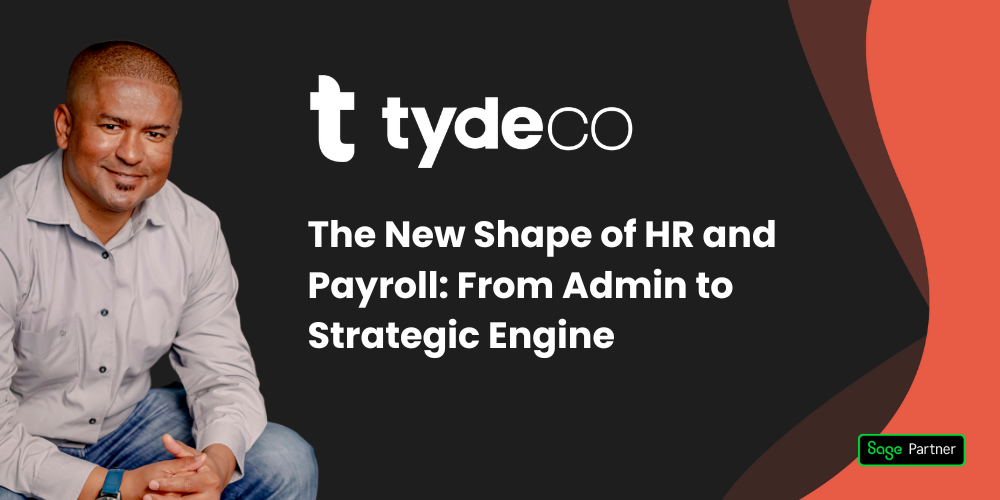
A Conversation with Ancel Draai, Senior Director, Growth – HRP (Human Resource & Payroll Services), UKIA
HR and payroll used to be the backstage crew. Quiet. Administrative. Necessary but not exactly headline material.
Not anymore.
In 2025, your people systems are either driving business growth—or dragging you into chaos. Yet, too many companies are still stuck in survival mode: manual processes, outdated software, and performance reviews that haven’t evolved since the fax machine.
Ancel Draai has witnessed firsthand how these systems can either propel a business or hold it back. As Senior Director of Growth for Human Resource & Payroll Services at Sage (UKIA), he’s played a key role in helping organisations transition from fragmented systems to unified, dynamic HR stacks that not only keep things running—but also drive business strategy.
In this conversation, Ancel discusses what’s changing in the HR and payroll landscape, what challenges still remain, and why businesses should never be wasting three days reconciling leave balances in Excel.
HR Belongs at the Strategy Table
Where should HR and payroll sit within today’s broader business strategy, and what role can they play in driving long-term company success?
In today’s world, it’s crucial for HR and payroll to be at the main table from a strategic perspective. For companies, especially those experiencing rapid growth like ours, it’s vital that HR goals align with business goals. We need to focus on attracting and retaining talent to ensure we have the right people in place to fuel that growth. HR directors and managers must be part of the strategic conversation to make sure the business moves in the right direction.
Compliance also plays a huge role in growth. When entering new markets, HR must ensure the company can meet legislative requirements. The impact of failing to comply can be severe—entering a market that’s blacklisted could have massive ramifications for the company.
It’s also essential for leaders to understand the importance of enhancing the employee experience. One of the biggest reasons top talent leaves an organisation is because they feel the experience wasn’t up to par. We often think it’s about compensation, but in many cases, it’s actually the relationship employees have with the organisation that matters most.
Another key point is operational efficiency. Salaries and wages are often the largest expense on a company’s income statement, so it’s strategic to think about how to manage that expense more effectively. And risk management is huge—employing the wrong people is a massive risk. That’s why HR must be involved in strategic decision-making to ensure the long-term health of the organisation.
“HR is involved when it comes to strategic decision-making for the future and health of an organization.”
Ancel Draai, Senior Director, Growth – HRP (Human Resource & Payroll Services), UKIA
Redefining HR’s Role
What are the key shifts that need to happen for HR to transition from an administrative function to a strategic contributor that actively drives growth and innovation?
Fantastic questions. Historically, HR and payroll departments were seen as sideline functions, there to ensure people got paid on time and to handle grievances when they arose. But there’s been a clear shift. More and more, companies focused on future success are moving HR and payroll away from being just administrative and data-capturing roles to being data-driven strategists.
Today, payroll and HR solutions store a massive amount of data, but often, we don’t do much with it. Companies are realising that a large portion of their data sits within these systems, and they’re not leveraging it to its full potential. There’s been a shift from merely capturing information to actively using that data to generate valuable insights—insights that can guide decisions like how to hire, which markets to target, and whether we have the resources to support these moves.
HR has traditionally been about writing policies and enforcing them. While policies remain important, the real power of HR today lies in its ability to drive innovation within the organisation. How can we work smarter, using the tools and resources we already have, and what do we need to acquire to get there?
Building a true partnership between leadership, HR, and payroll is essential for addressing these concerns and creating a path forward focused on future growth.
“Companies realise that almost all the data that we have within our company sits within our payroll and HR solutions, and we’re not doing much with that.”
Ancel Draai, Senior Director, Growth – HRP (Human Resource & Payroll Services), UKIA
The Anatomy of a Modern HR Stack
What essential components make up a modern HR and payroll stack, and how does the right stack directly influence the business’s ability to scale?
It’s crucial that businesses move from being reactive to proactive in the way they shape their growth strategies. Historically, companies have often reacted to situations as they arise, but today’s organisations are striving to be more proactive—particularly when it comes to the solutions they bring into their HR and payroll systems to drive growth.
The key to being proactive is having access to more data. You need data to assess where you are, so you can strategically determine where you want to go.
When it comes to payroll and HR, the process often starts with recruitment and extends through the entire lifecycle of an employee, from onboarding to off-boarding. The challenge is that many companies are still searching for a single solution that encompasses all of these stages, but the reality is that no such solution exists on the market, even at the enterprise level.
What companies should focus on is finding core applications that address both payroll and HR. However, these solutions need to be flexible enough to integrate seamlessly with other systems. For example, if you have a great recruitment application, it should integrate smoothly with your payroll and HR systems. The same goes for onboarding solutions. It’s essential that these solutions work together seamlessly to create an integrated experience that helps attract and retain the right talent for your organisation.
“So it is vitally important that these solutions speak to each other so that you get the experience that is required for your organisation to either attract talent to your organisation or, again, to retain the talent that is there.”
Ancel Draai, Senior Director, Growth – HRP (Human Resource & Payroll Services), UKIA
Use Automation to Create Space for Strategy
How can companies effectively balance automation with human insight, ensuring that technology empowers HR teams to focus on strategic decision-making instead of administrative tasks?
Automation is absolutely critical for any organisation today. The old way of relying on paper-based solutions just isn’t practical anymore. We live in a fast-paced world, and it’s essential that everything works efficiently. Let me give you an example.
In South Africa, companies often post job ads that attract thousands of applicants. The idea of a recruitment manager going through a thousand CVs manually is unrealistic unless they have months to fill the position. But there just isn’t time for that.
What we need are solutions that can automate the process. For example, if I’m hiring for a position and I’m looking for someone with five years of experience and a finance degree, the system should be able to filter through applications and send regret letters to the applicants who didn’t make it. For those who are shortlisted, the system should automatically send an email or SMS to notify them that they’ve moved to the next step.
If we had to do all of this manually, it would take days or even weeks. With automation, it happens in seconds, allowing us to move on to the next step faster. This streamlines the entire process, makes it more accurate, and ensures we’re engaging with the right candidates. It’s not just about being efficient; it’s about getting the right people and managing them well.
Even within an organisation, tasks like leave approval, payslips, and expense claims are all automated now. What was once seen as a nice-to-have is now a necessity if businesses want to retain talent and thrive in the future.
“When we have those kinds of automations in place, it just makes things a lot quicker, a lot more accurate. We have the right candidates that we want them to deal with.”
Ancel Draai, Senior Director, Growth – HRP (Human Resource & Payroll Services), UKIA
Measure What Moves the Needle
What are the key performance metrics HR and payroll teams should track to truly understand their impact on the business and drive smarter decisions across the organisation?
When it comes to tracking performance, it is critical for companies to take a granular approach. As I mentioned before, salaries and wages are often the largest expense on an income statement, so payroll and HR need to manage this expense on a detailed level.
Workforce productivity and cost efficiency are key metrics here. If these aren’t managed carefully, you could end up with a ballooning overtime bill because employee productivity isn’t being monitored closely, especially for those paid based on hours worked.
It’s also vital to focus on talent retention. Replacing high-quality employees can cost a company tens of thousands of rands or dollars—getting someone up to the same level of expertise takes time and resources. Retaining talent becomes even more important when considering how much value those individuals add to the organisation.
Additionally, employees today want more engagement and access to data, so regular communication is necessary. It’s no longer enough to only conduct annual performance reviews. Instead, a more agile approach, with ongoing feedback, is essential to keeping employees engaged and retained.
Another area that can’t be overlooked is payroll accuracy. Many payroll solutions are still prone to manual errors, which are caused by human intervention. This can lead to discrepancies and inefficiencies. Modern HR systems need to integrate seamlessly so that payroll data is automatically updated without human intervention, except for final approval.
And finally, compliance. From a payroll perspective, compliance is non-negotiable. The tax deductions and the earnings that employees receive must be accurate to avoid the financial penalties from regulatory bodies. HR compliance is equally important, as the labour laws need to be in full alignment with the country where the business operates.
“So when it comes to tracking performance, it is very, very important that companies really look at this on a granular level.”
Ancel Draai, Senior Director, Growth – HRP (Human Resource & Payroll Services), UKIA
Performance Reviews Need a Rethink
Why is the traditional approach to performance management no longer effective, and how can companies redesign their performance reviews to better support employee growth and organisational success?
Performance management has become a louder and more pressing topic in organisations. The old approach to performance reviews was more of a reactive process, done simply because it was expected. It was a way to justify why someone received a bonus or a raise, but it didn’t really manage performance. The focus was on evaluating past performance rather than on driving improvement.
Many companies have shifted away from that outdated model. Now, they are looking at performance much more frequently, not just at year-end or when bonuses are due. The modern employee expects continuous feedback to adapt to the ever-changing demands of the organisation. Companies also need to be agile and responsive in a competitive market.
Traditionally, many companies have used rating scales, like 4 out of 5 or 3 out of 5, which can be demoralising for employees. Today, the focus is more on skills assessments to ensure employees have the right tools to achieve the goals that support the organisation’s growth. It’s not just about checking off goals from the previous year but about assessing whether employees are performing in a way that helps the company scale.
This approach requires companies to redefine how performance is managed. First, they need to identify their strategic goals. Then, they can evaluate what needs to be done to ensure employees are equipped to drive that growth.
“Once we’ve defined that on a strategic level, we can then go backwards and say, what do we need to do to get the performance out of the employees? To drive the growth that we’re looking for on a strategic level.”
Ancel Draai, Senior Director, Growth – HRP (Human Resource & Payroll Services), UKIA
Payroll Should Run in Real Time
What is driving the urgent shift towards faster, more responsive payroll systems, and why is it becoming increasingly crucial for businesses to provide real-time payroll for their employees?
There’s an increasing demand in the market for companies to be more agile, especially when it comes to giving employees access to their earnings before the end of the month. There are now tools available that integrate with payroll solutions to allow employees to access a portion of their pay sooner.
For example, companies like PayMeNow provide a software application that integrates seamlessly into payroll systems, allowing employees to access their funds as needed. This type of flexibility is becoming a must-have for employees, who are now expecting this agility from HR departments.
These solutions not only provide employees with the ability to access money when they need it, but they also build formal buy-in from employees toward the company’s objectives. When employees feel empowered—like being able to get taxi fare money on short notice—they feel more connected and committed to the company’s goals.
Additionally, with the rise of remote and hybrid work, organisations with global teams are seeking solutions that can accommodate various remuneration models, such as paying employees in different currencies like USD or Rands. Technology must be able to cater to this growing demand to support flexible work arrangements, regardless of where employees are located.
“Employees are looking for that agility and demanding that almost from the parallel HR department.”
Ancel Draai, Senior Director, Growth – HRP (Human Resource & Payroll Services), UKIA
Built for the Individual
How are employee expectations around personalisation changing the design of HR and payroll systems, and what does this mean for businesses striving to deliver better employee experiences?
Companies are increasingly looking to be more flexible in order to attract and retain talent. One of the ways they’re doing this is by offering personalised remuneration options. This can range from on-demand access to pay, allowing employees to choose how and when they are paid, to offering different pay schedules—weekly, fortnightly, or even hourly.
For example, in industries like agriculture, where remuneration is based on both hours worked and productivity, HR and payroll systems need to be adaptable enough to handle these complexities. Employees in these sectors are compensated based on how much work they’ve done, such as how many crates of fruit they’ve packed. This requires systems that can track both time and output, while also ensuring accurate pay processing.
The modern workforce expects these systems to be flexible and personalised, as well as to integrate seamlessly into their daily lives. The flexibility of pay options, personalised experiences, and responsiveness in technology are all factors that contribute to a better employee experience. This shift toward personalisation is not only about meeting employee expectations but also about aligning organisational needs with talent retention and satisfaction.
“Companies are looking at ways in which they can customise the way they remunerate somebody, sometimes with things like on-demand access.”
Ancel Draai, Senior Director, Growth – HRP (Human Resource & Payroll Services), UKIA
Built Into the Everyday
Where should HR technology be embedded in the daily employee journey to ensure it provides enhanced support, engagement, and performance?
When it comes to seamless workflow integration within an organisation, that’s what you should expect from an HR technology stack. HR tools should be easily accessible to employees, allowing them to engage with the platform efficiently. For instance, if an employee moves and needs to update their address, they should be able to do it seamlessly within the system.
Moreover, if there are surveys or feedback requests we need from employees, those too can be managed through the platform, ensuring more engagement and better insights. The modern employee is much more engaged through technology, and this engagement is critical to making informed decisions that impact both employee retention and organisational health.
Additionally, as companies move towards more digital solutions, tools like chatbots are becoming essential. They allow employees to get quick answers and support, without needing to rely solely on human resources for every enquiry. If the chatbot can’t provide the answer, it can seamlessly escalate the issue to a human representative.
Personalised growth touchpoints are also key. It’s crucial that employees feel they’re not stagnating in their role. Offering them opportunities for learning, attending courses, or having a tailored development plan fosters greater engagement. The more personalised the experience, the more invested employees will be in their role and in the company, which ultimately leads to a more dynamic, growth-driven organisation.
“The more personalised we make it for an employee, the more engaged they are within the organisation.”
Ancel Draai, Senior Director, Growth – HRP (Human Resource & Payroll Services), UKIA
Your Tools Should Talk to Each Other
What’s needed to create a more connected HR and payroll ecosystem, and why is integration across systems so critical for improving efficiency, data accuracy, and decision-making?
One of the biggest challenges I’ve seen in the market is the prevalence of manual processes. Even today, companies still rely on outdated methods that introduce human error. The way data is input into various systems, whether it’s Excel, Word, or manual files, is not only time-consuming but also prone to mistakes.
Getting data out of these systems is equally time-consuming. Manual processes often lead to miscalculations, which means the data we rely on can’t be clean or accurate. This results in payroll mistakes, HR errors, and even potential ghost employees due to missed terminations. The risks associated with this are significant, and it leads to frustrated employees who see the inefficiencies in the way business is conducted internally.
This is where Sage solutions come in. By automating processes, we can manage the entire employee lifecycle, from leave management to automated payslips and IRP-5 generation. Employees can update personal information, claim expenses, and get the necessary documents without the need for manual intervention.
Automation also enables the system to generate valuable analytics that provide insights into your organisation’s health. The integration of systems allows data to flow seamlessly, improving decision-making and ensuring that operations run more efficiently and with greater accuracy. This is the future of HR and payroll management—systems that work together to eliminate manual errors and improve organisational outcomes.
“By automating processes, we can manage the entire employee lifecycle, from leave management to automated payslips and IRP-5 generation.”
Ancel Draai, Senior Director, Growth – HRP (Human Resource & Payroll Services), UKIA
The Future Won’t Wait for Manual Work
What’s your advice for leaders who are still relying on legacy systems and manual processes in HR and payroll, and how can they start transitioning to more modern, efficient solutions that will keep them competitive?
Your company will generally be left behind if you don’t adapt to the ever-changing market and the way employees engage a particular company. Not just employees, but candidates—the right candidate for your organisation—the way they engage your organisation is critical for your organisation.
So it’s important that leaders have a look at the systems that they have in place to be able to attract talent and retain talent within there. It’s important to identify that you have the right solutions that are able to manage your cost.
So I’m speaking to the CFOs out there to manage the cost efficiently, to make certain that we are accurately managing the data that speaks to our largest expense on our income statement.
A lot of companies tend to now move towards the cloud because that’s the way of the future. And also, we don’t have to then invest in the infrastructure needed for these kinds of solutions as well.
So when it comes to compliance, updates can be done seamlessly because the solution is in the cloud. It’s not me having to wait for a file I need to download. I need to install the file. All of this happens seamlessly.
It is important obviously that when you acquire solutions or look at solutions that are scalable with your organisation to say that I may only have fifty employees now but based on our growth strategy we will have five hundred employees within the next three years.
Does the solution actually speak to that and make sure that it can scale with our organisation as well? And does the solution as well integrate with other solutions like a finance solution that our employee costs can be pushed in through our finance solution, that a time and attendance application can speak to our payroll system as well?
And those are the things that we need to have a look at. And then prioritise change management. Change management is something that people tend to forget when implementing anything within the organisation, that there’s still the human side when it comes to managing the change within an organisation.
And it’s important, obviously, to make certain that people are trained properly on these solutions, that they use it in a way that is strategic for the organisation. So we’re not just copying and pasting from where we were to where we are now, we actually go in and say, what can these solutions actually do for us that we’re currently not getting?
And how can we change our organisation to give us the outputs that we are looking for that previously were borderline impossible to get? Or else we needed to get someone to create a spreadsheet for us that would take two to three weeks to give us the information that we’re looking for.
Now we have a solution that with a click of a button, we’re able to get the information that we’re looking for so that we as leaders can make strategic decisions for our organisation.
And that’s why it’s so important to be able to bring solutions that transform your organisation to a place where it drives growth and you are able to thrive.
“Your company will generally be left behind if you don’t adapt to the ever-changing market and the way employees engage with your company.”
Ancel Draai, Senior Director, Growth – HRP (Human Resource & Payroll Services), UKIA

You must be logged in to post a comment.